

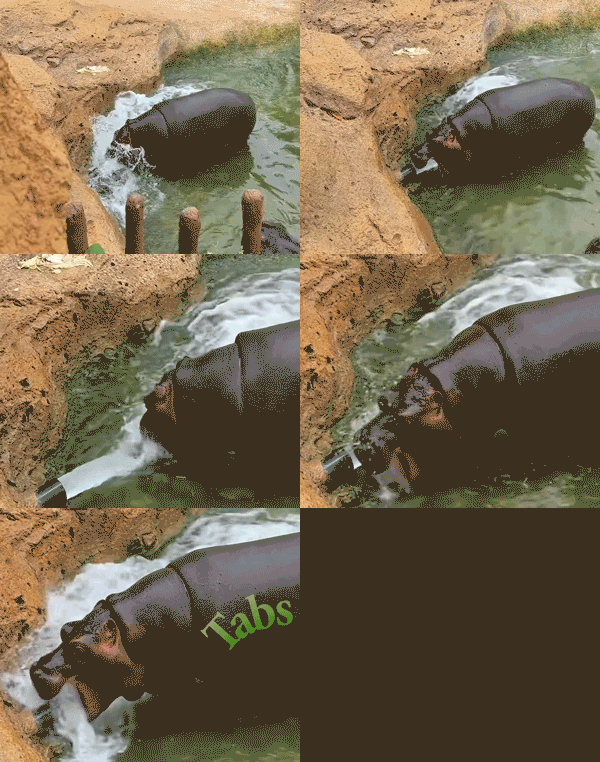
Chinese zookeeper Chen Jiaxi, who goes by the social media handle chenjiaxi_cj, takes copious videos of his animal charges, particularly of his hippopotamus friend, who I think goes by the name of Masti if I am following the hashtags correctly. This hippo is a character! As well as enjoying many different treats (and if you like giant hippo mouths crunching on things, click through to Chen’s Instagram feed), he also loves to gulp all the water he can. Big, big thirst!
In the wild, hippos are certainly big consumers of water, using it for both hydration and for cooling off from the sweltering sub-Saharan African savannas where they live. They consume about 40 gallons of water a day, which is conveniently located right where they spend their days, in the rivers and ponds of their environment. They spend most of their daytime hours mostly submerged, protecting their mostly-hairless skin from sunburn, and emerge at night to graze. While they don’t really swim, they easily move about by bouncing off the lakebeds and river bottoms where they rest. They can even sleep underwater, subconsciously floating back to the surface to take a breath as needed. Adult hippopotamuses need to take a breath about once every five minutes. Young hippos need to pop up their little noses to take in air about every two minutes.
Genetic and morphological evidence show that hippopotamuses are relatives to cetaceans, that order of aquatic mammals that include whales, porpoises and dolphins. The two groups share a common ancestor that lived about 55 million years ago. There is some debate as to whether the last common ancestor of cetaceans and hippos was terrestrial, semi-aquatic or entirely aquatic. However recent research suggests that the aquatic traits of hippos are a result of convergent evolution, and their last common ancestor was a land-dwelling mammal, probably possessing some semi-aquatic traits.
Regardless, their common lineage explains some shared traits between modern day whales and hippos. Both retain the multi-chambered stomach configuration of ruminants, although instead of the cud-chewing regurgitation process employed by modern-day ruminants, whales and hippos use their first stomachs as fermentation chambers to break down food before passing the results to their final “true” stomach. Another similarity is large lung capacity that enables these air-breathing mammals to spend long periods submerged. In both animals, the lungs are single-lobed which permit quick expulsion and refilling of fresh air before going underwater again. Hippos posses a thick layer of fat at the skin, similar to a whale’s blubber, and hippos have webbing between their toes, similar to a whale’s flippers. And both whales and hippos have a large larynx developed for emitting booming calls underwater, enabling communication while submerged.
Possessing the physical characteristics to live happily in the water, hippos inhabit a unique adaptive niche. Most of the animals in their environments live and compete on land, but hippos stay happily submerged, limiting their land-based efforts to nocturnal foraging and territory marking. Living in aqueous environments, the grasses that they like conveniently typically grow nearby, limiting the metabolic work that the big animals need to expend to replenish themselves (although they have been recorded ranging up to 15 kilometers in search of a meal). However, their water-based adaptation comes with a downside: skin that can burn and crack with sun exposure. While aquatic mammals evolved without sweat glands, hippos developed a specialized sweat glad that produces “blood sweat,” an excretion that protects the skin from the sun and keeps the hippo’s skin hydrated when it is out of the water. The reddish excretion isn’t really sweat and although it looks a little like blood it is in fact tinted by acidic pigments that inhibit bacteria and protect from light-absorption of rays in the ultraviolet range.
Another benefit of a living in water is that it confers extra protection to calves from land-based predators. Hippos have a gestation period that is relatively short for large mammals—about 8 months. Calves will continue to develop outside of the womb in their watery environment, and can even nurse underwater. This more efficient gestation and their other adaptations allows hippos to be more energy efficient, improving overall odds of survival in a harsh environment.
The source for today’s gif is here.
Londolozi Blog: “Why do Hippos Live in Water ?” by Nick Sims, 6/16/19
Animals Wild Facts: “Top 13 Animals that Drink a lot of Water (With Images)” by AliSeo 12/15/25
"Not many people are aware of this, children, but every morning, hippos must repressurize with water to get the wrinkles out!"
The cleanest teeth in hippodom are probably the cleanest in the animal kingdom, yikes!
Oh no! That hippo is drinking all the water leaving none for the rest of us! It is just like a data center only cuter. Thanks, Martini!