

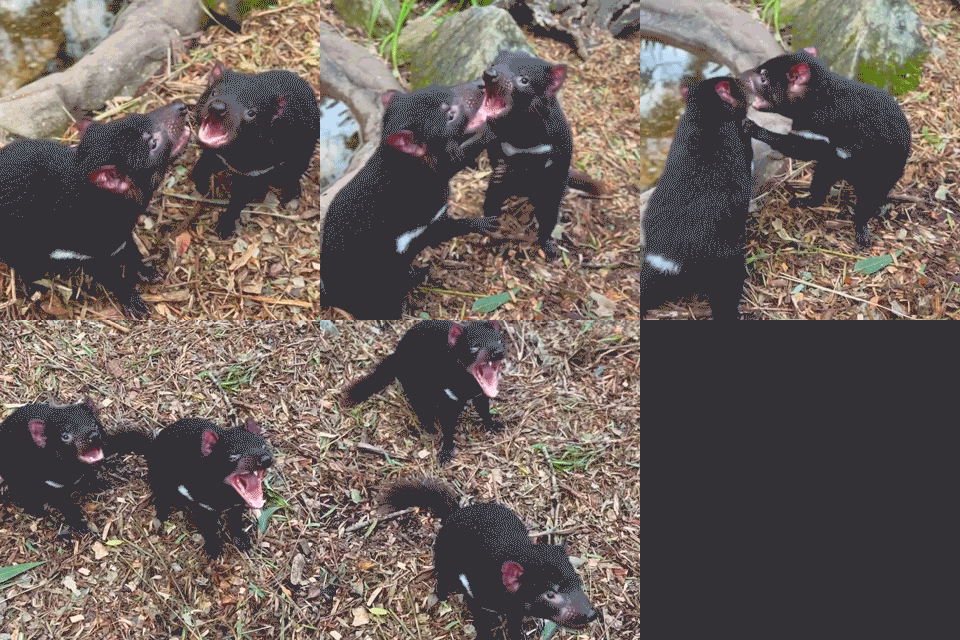
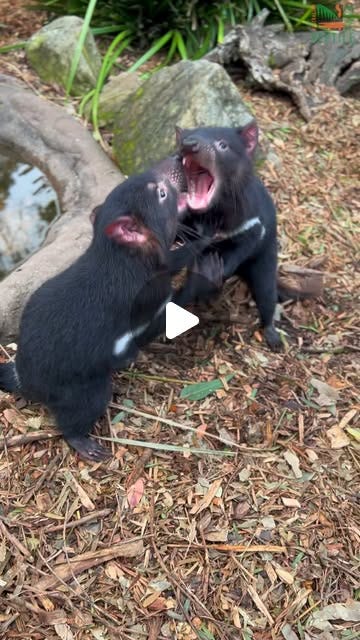
Today’s gif has a couple of young Tasmanian devil pups play fighting and generally being their loud and proud selves. These little guys love to vocalize. It’s a skill that they will need as they navigate their social interactions later in life. Adults use vocalizations to communicate, particularly when they particulate in group mealtimes. While devils were once considered solitary and combative, research has shown that they do live in distributed social networks and females in particular are not aggressively territorial beyond defending their young.
As their name suggests, Tasmanian devils are native to the Tasmania island state of Australia. Fossil records show that they were once present on mainland Australia until sometime about 3000 years ago (but maybe as recently as 400 years ago, depending on the expert you ask). They are the largest extant carnivorous marsupial and are members of that taxonomical order Dasyuromorphia that we’ve seen in marsupial madness posts from a few weeks ago. In fact, devils are most closely related to quolls, their evolutionary lineage probably splitting somewhere 3.6-2.6 million years ago in the Late Pliocene.

Tasmanian devils are roughly the size of a small, sturdy dog, with males (25.7 inches long on average and weighting about 18 pounds) usually larger than females (about 22 inches and 13 pounds). They are squat and solidly built, with the most powerful bite strength relative to size of any living mammalian carnivore. They do not sweat, but pant to release heat. Their forelegs are longer than their rear legs, giving them a lumbering gait. With their ponderous stride, panting, powerful hyena-like jaws and carnivorous nature, early European settlers might be forgiven for thinking they are related to dogs or even bears, but they are not, being firmly in the marsupial family. Their canine-like adaptations are a result of convergent evolution.
Devils are mostly solitary, but they will interact with others in their vicinity. Although they do hunt small mammals (or even larger ones if the opportunity arises), birds and insects, they are primarily scavengers. Nocturnal forgers, they’ll travel an average of 5.3 miles a night to find whatever carrion they can eat, and they play an important role in keeping their environment clean.
It is their practice of carrion foraging that brings devils in closer proximity to each other. Up to twelve devils may feed at a single site (although about five is more common), the gatherings being a raucous affair, with much vocalizing and jockeying. Unfortunately, this is also a time when they are most likely to be exposed to other devils that might be infected. Devil Facial Tumor Disease (DFTD) has ravaged the population, with estimates that this contagious cancer has resulted in a 20 to 80 percent decline in the last three decades. Researchers are finally unlocking the way DFTD mutates and recent vaccine trials are showing promise in slowing its progression. Concurrently, ongoing efforts are focused on removing infected individuals from the wild population.
Tasmanian devils are listed by the IUCN as endangered. As well as threats from disease, they are vulnerable to traffic collisions due to their habit of scavenging road kill, and they also are experiencing habitat loss. Selected zoos and reserves on the Australian mainland and around the world are aiding the Australian species survival program through captive breeding.
Cute, noisy critters!
Wait, so they don't go around as little tornado clouds??!?