

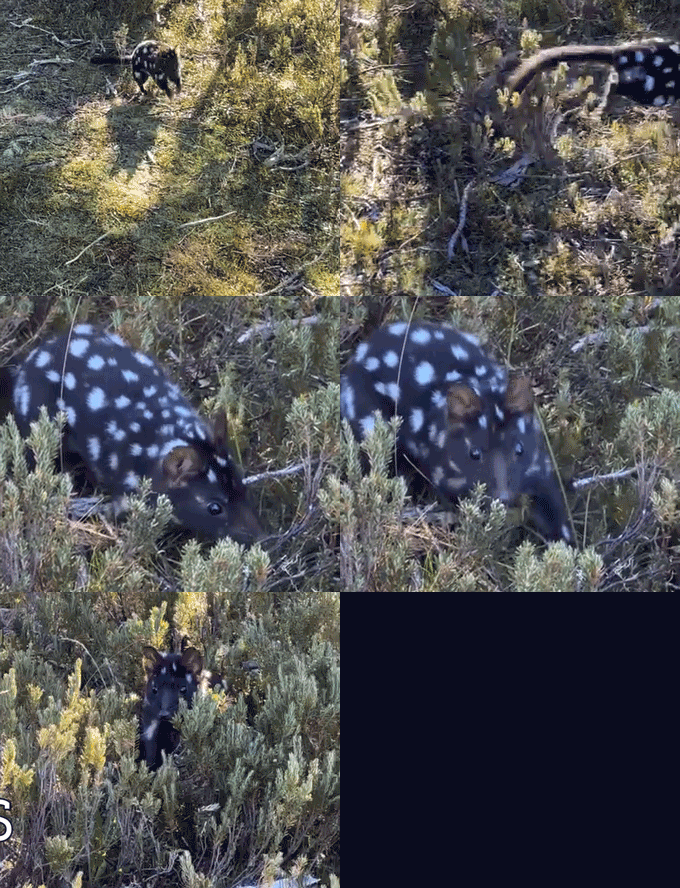
Check out those spots! Today’s gif animal is a quoll, an eastern quoll to be specific. I think this guy is eating a nice, juicy insect, but is getting a big bit of bush salad in that mouthful. Roughage is good for you.
Quolls are of the genus Dasyurus, which contains six extant species. Dasyrus belongs to the order of Dasyuromorphia, which you may remember from yesterday’s post on numbats, includes most of the carnivorous marsupials in Australia. And indeed, quolls are carnivores; eating small mammals, small birds, reptlies, amphibians and insects as available in their habitat. They will scavenge for carrion if available, and are known for stealing Tasmanian devils’ leftovers. They are indigenous to mainland Australia, New Guinea and Tasmania, but their numbers are greatly reduced. They are primarily terrestrial, but they have adapted some arboreal traits and can easily climb trees if necessary. They are on the whole nocturnal, but can sometimes be spotted hunting during daylight hours.
Genetic evidence indicates that quolls evolved around 15 million years ago and that the ancestors of the six species had all diverged by around four million years ago. Each species of quoll lives in distinct geographical areas. While their size and coloration varies by species, one thing that they have in common is that they exhibit bio fluorescence under ultraviolet light, which is cool, but I can’t fathom a reason why they’d evolve this trait. Some scientists speculate that biofluorescence may be a communication or defense mechanism, or something that influences mating preferences, but they don’t really know for sure. In any event, they are probably fun to bring to raves and blacklight parties, and maybe are having absolute bangers in the Australian outback. If any quolls are reading this, please send me an invitation. I’ll bring the beer.
Besides the giant parties that I imagine are happening, quolls are solitary animals, staking out and defending turf from interlopers. Males and females have overlapping territories, but they will only meet up during mating season (which is in winter), staying apart the rest of the year. Once a female quoll has been impregnated, the folds on her abdomen develop into a pouch that opens at the back (although one species, spotted-tailed quoll, has a true pouch). Gestation is about 21 days, depending on the species. Joeys are tiny, about the size of a grain of rice at birth. They fuse to the mother’s teats and suckle milk in their mother's pouch for six to eight weeks, and then afterwards they will be deposited in their den, where they will remain for at least a month.
Eastern quolls like the one in our header are found on Australia’s island state of Tasmania. They once were also present across much of southeastern mainland Australia, but that population became functionally extinct in the 1960’s due to predation by introduced foxes. Like other quolls, they are carnivores, but they do also eat some plant matter such as grass and seasonally-available fruit. Males range in size from about 21 to 26 inches long (tail included) and weigh about two-and-a-half pounds, while females are smaller at 19 to 23 inches with a weight of about one-and-a-half pounds. There are two different fur morphs: the black and white spotted version as we see in today’s gif, or a fawn spotted coat.
The eastern quoll is currently listed as endangered by the IUCN. Conservation efforts are underway to rebuild wild populations through reintroduction of captive bred eastern and other threatened species of quolls into selected fox-proofed areas of mainland Australia. A survey concluded recently in western Victoria is showing that quoll reintroduction is showing promise, with twelve new wild-born eastern quolls observed after three pregnant females and two males were released two years ago.
The source for today’s gif is below.
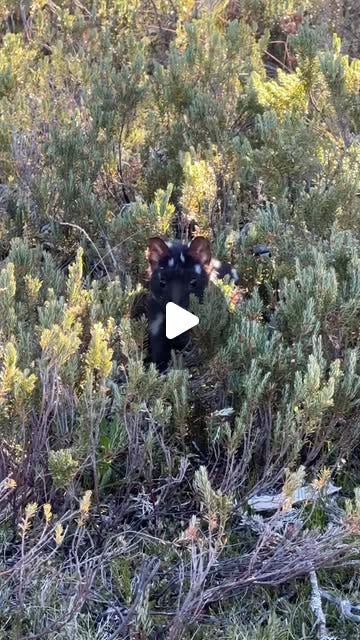
"This is my eastern quoll. I call him Fido because Spot is too obvious and a terrible name."
So, it turns out that marsupials are fascinating, diverse, clever and cute! A whole week of 'em is barely an introduction, but a fine sharpener of curiosity...
Thank you, I'm grateful for this, something I wouldn't have looked at myself.
"which you may remember from yesterday’s post on numbats"
I didn't know there was going to be a quiz!
Thank you! It's been a fun, informative, adorable week!