
Something New, Something Blue, Something Cuuuute
New tiny species of octopus discovered in the Galapagos waters

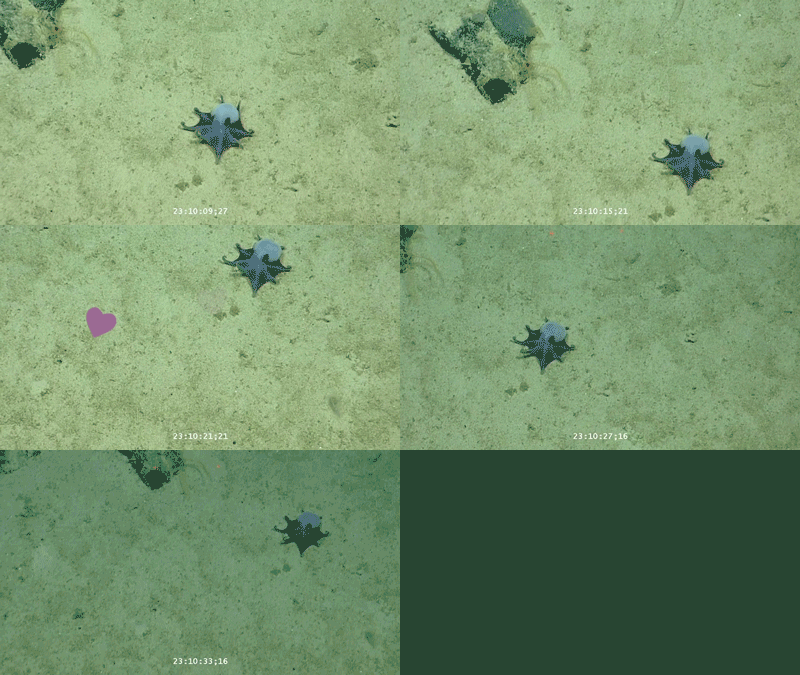
During a ten-day expedition of the Galápagos archipelago in July of 2015, researchers aboard the E/V Nautilus launched their robotic sub Hercules just off the coast of Darwin Island. It was there, on an underwater mountainside at a depth of 1,773 meters (5817 feet), that they discovered a little blue octopus. They soon located a few others, all about the size of a golf ball.
They collected one for study and put it aside for identification. Still, after some years passed, they were unable to identify the cephalopod. So they called in an expert. They sent an image to Janet Voight, curator emerita of invertebrates at the Field Museum in Chicago. “Right away, I knew it was something really special,” said Voight. “I’d never seen anything like it.” She is the lead author on a new paper describing the find published in the scientific journal Zootaxa, dated May 25, 2026.
Preserved in alcohol and formalin, they sent the collected sample to Chicago for examination. Realizing that the octopus was unique, Voight looked for non-destructive means to study it. “When you describe a new species of octopus, you have to look at all the parts, including the mouth, the beak, and the teeth. And to see those things, you have to cut the specimen open. We only had the one specimen, so I didn’t want to take it apart,” she explained.
She contacted Stephanie Smith, the manager of the Field Museum’s X-ray computed tomography laboratory. Using micro CT scans of the octopus, the team was able to see the fine details of the octopus’ internal organs and mouth, helping to confirm that the little blue octopus was indeed a new species. It has been named Microeledone galapagensis, in recognition of the place where it was discovered.
The little blue octopus has been placed in the Microeledone genus. The other species in this group is the Microeledone mangoldi, the sickle-tooth pygmy octopus, discovered in 2004. Mangoldi is small and has smooth skin, a large central tooth and a large funnel organ—traits that define both species in the genus. The differentiating quality between the two is primarily the distribution of color inside their mantles. Other defining features of Microeledone galapagensis are that it has only a small number of arm suckers and lack of ink sac.
“These are little octopuses that live in the deep sea, and hardly anybody on Earth has ever gotten to see them. I just feel lucky that I got to work with them,” says Voight.
The source for today’s gif taken from the article linked below.
Zootaxa: “A new species of Microeledone from Galápagos Islands and an amended diagnosis of the Megaleledonidae (Octopoda: Incirrata)” by Janet R. Voight et al, 5/24/26
Nature just keeps on delighting! What marvelous creatures. I'm almost wishing that they weren't discovered
Let us hope that the avaricious, shameless moneybelts do not decide that these wee miracles are "fashionable accessories"...
Cute little critters! Ain't nature wonderful!