

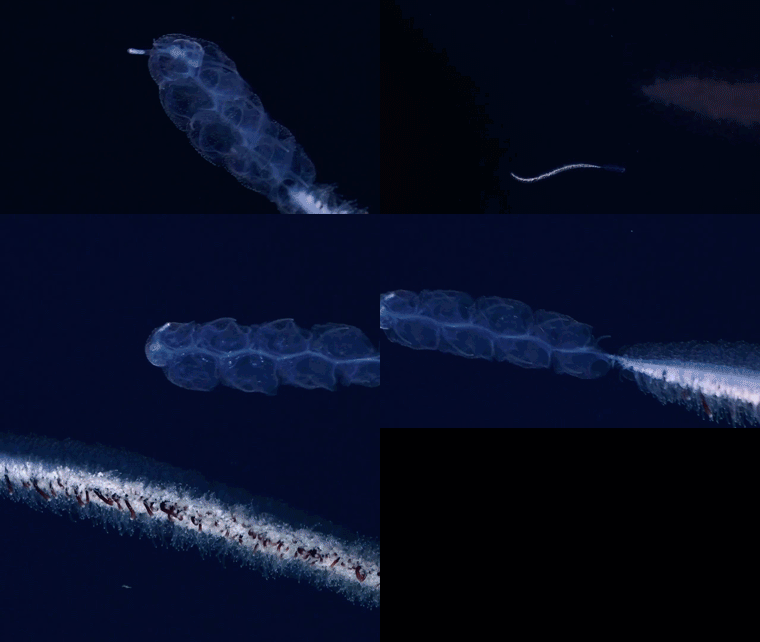
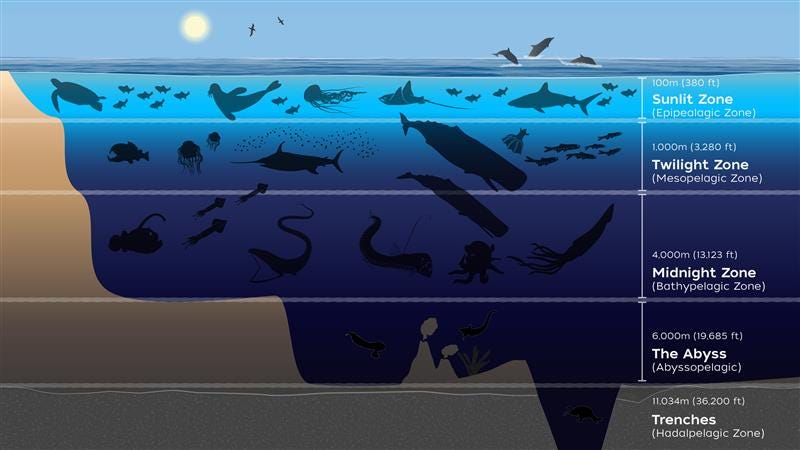
Today’s gif is taken from some underwater footage filmed by the Remote Operating Vehicle (ROV) SuBastian piloted by the team at Schmidt Ocean. It’s a siphonophore, and a new species, never before seen. The scientists and researchers monitoring the feed were particularly excited to be able to zoom in to watch the zooids responsible for motion—nectophores, or swimming bells—which are the series of valves at the front of the organism. The footage was filmed off the coast of Brazil in the tropical South Atlantic Ocean at 897 meters (that’s 2943 feet) below sea level, in the ocean’s Twilight Zone.
For a refresher on zooids how they form a siphonophore, click the story here…

Due to their delicate, gelatinous nature, it’s difficult to collect samples of siphonophores for study. The Schmidt team is employing new high-tech methods for collecting data on this and other organisms that they have observed in their deep sea dives. The ROV is equipped with an shadowgraph imaging device that can perform CT (computerized tomography) scans, enabling the team to create highly accurate 3D digital models, called “virtual holotypes.” By measuring the shadow an object casts, the internal and external structures of gelatinous creatures are revealed in a more accurate way than other imaging systems can show. These models are invaluable in scientifically describing observed species, particularly those that cannot be inspected through conventional means.
SuBastian was also equipped with a Deep Particle Image Velocimetry instrument (which they call “DeepPIV”), which can illuminate a sheet of fluid and measure how it moves around an animal. This helps observers assess how the animal might use the fluid for locomotion, feeding and reproduction. DeepPIV also provides data to generate 3D portraits, enabling researchers to inspect aspects of the organism’s physical structure, providing a snapshot in time of how the animal appears in its natural environment. And it looks like a groovy underwater laser show, so that’s cool too! Click through the link below to see it in action on another siphonophore.
All together DesigningTheFuture3, the latest Schmidt expedition—a team of engineers, zoologists, computer scientists, bioinformaticians and taxonomists specializing in Mesopelagic zone organisms—observed 31 new deep water species. While it can take up to decades to identify new species (like our little blue octopus friend from a few weeks ago), Schmidt credits the team’s shared collective expertise and new technologies in enabling them to move quickly and accurately in defining these new species.

Today’s source is linked here.
Marine Technology News: “Schmidt Ocean Institute Research Team Discovers 31 New Species,”6/4/26
Yay, Science!
We covered something about this (or lateral to it).
Five hundred million years ago, give or take, something that was not yet an animal became one, and nobody saw it happen. This week, in a lab in Jena, Germany, somebody got as close to watching it as we may ever get. Researchers found an embryonic "organizer" — the master switch that tells a clump of cells what kind of body to build — inside a comb jelly, one of the oldest branches on the animal tree, and then transplanted those cells into a sea anemone from a completely different phylum, where they grew an entire extra mouth and pharynx.
https://thistleandmoss.com/p/what-survives-the-morning-the-burning-doesn-t-ask-permission-and-neither-does-the-green-coming-up-th#what-did-we-do-to-the-mother-today