

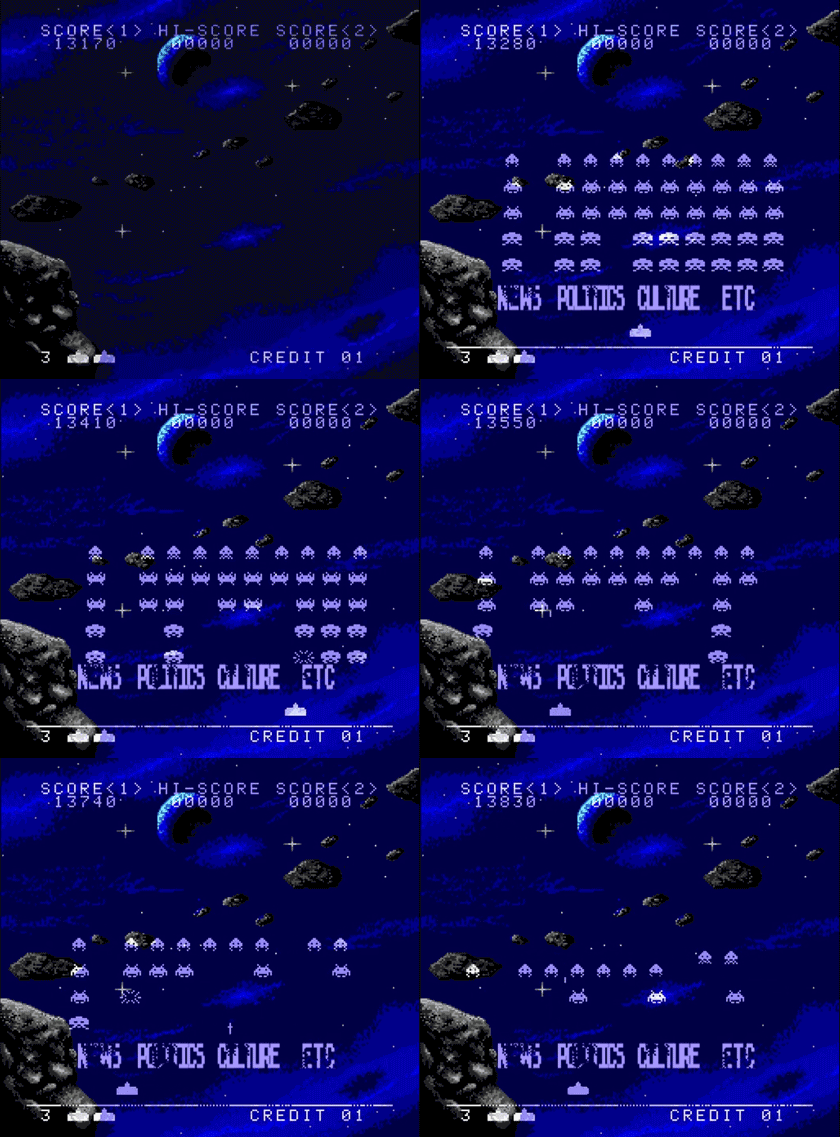
In our hed gif today we are watching some live play from the shoot-em-up game Space Invaders. Released in 1978 by Taito (and outside of Japan under the corporate name Midway), Space Invaders was the first fixed shooter video game, the goal being destroying the advancing rows of alien spaceships before they descended and got you instead. This was one of the games I remember my friends playing in the video arcade, when that was still a thing that teens did. Me? I did not play beyond a few attempts. Shooty style video games were never really my thing. And plus, my reflexes were horrible and I was always knocked out in the first or second round. I was not willing to feed my hard-earned quarters into a machine in a quest to improve that particular skill.
But despite my inability to master the game, Space Invaders proved wildly successful. Any concerns that video game vendors had of the game being too complex to catch on quickly vanished. In 1982, the arcade game had grossed $3.8 billion (inflation adjusted that’s about $12.2 billion today in 2024), with a net profit of $450 million (about 1.4 billion in today’s dollars). Customers became addicted, playing for hours on end and production sites worked overnight shifts to keep up with demand. The original cabinet and tabletop platforms were continuously enhanced and modified for new audiences, and in 1980 a home version was licensed for the Atari 2600 console. By 1982, versions were available for handheld electronic game devices, home computers, watches and pocket calculators.
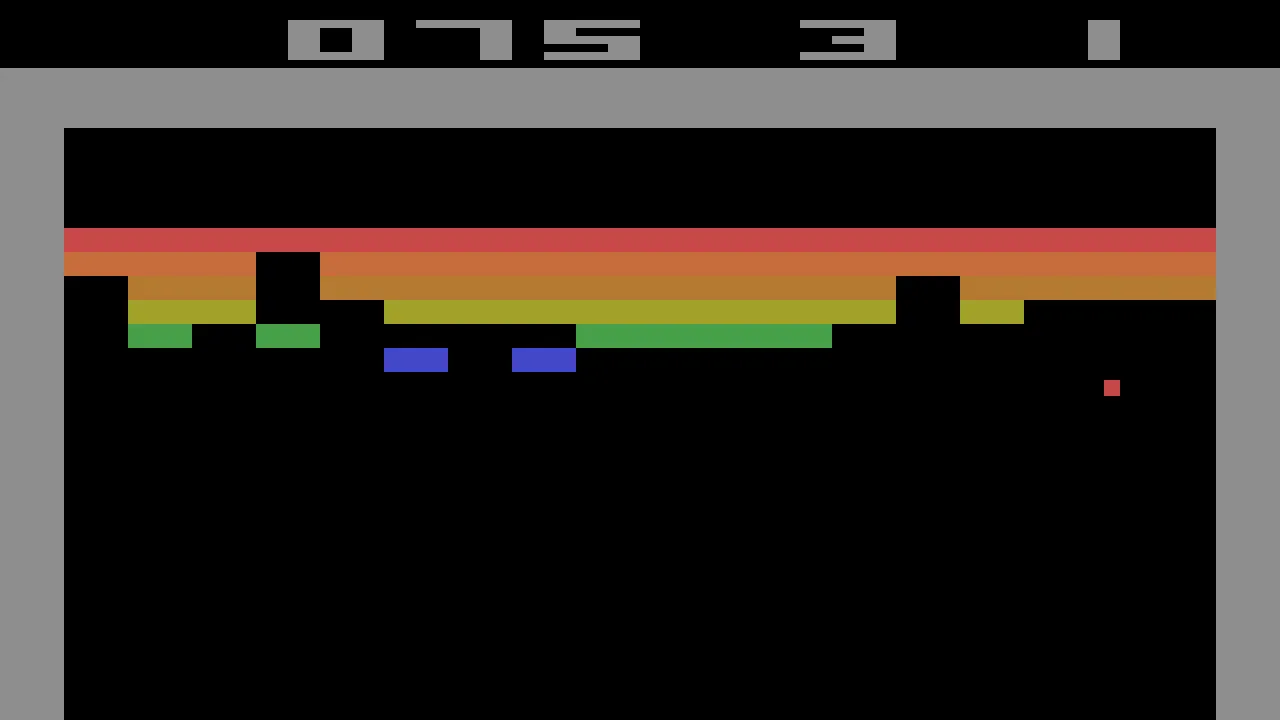
The game‘s existence is thanks to creator Tomohiro Nishikado, whose re-engineered and re-imagined concepts have had a profound and lasting influence on video gaming. Nishikado recalls being enthralled with Atari’s Breakout, so when he was approached by Taito to create a game that would compete with Atari’s hit, he was well-suited to the challenge having already thought about how gameplay could be improved. Whereas shooting style games up to that point were time-based, Nishikado designed his new game to be based on “lives”—in other words, game play not limited by time, but instead based on a set number of tries to advance before being knocked out. As the game progressed, play became more difficult and attacks from the game intensified, so the chance of losing a life increased.
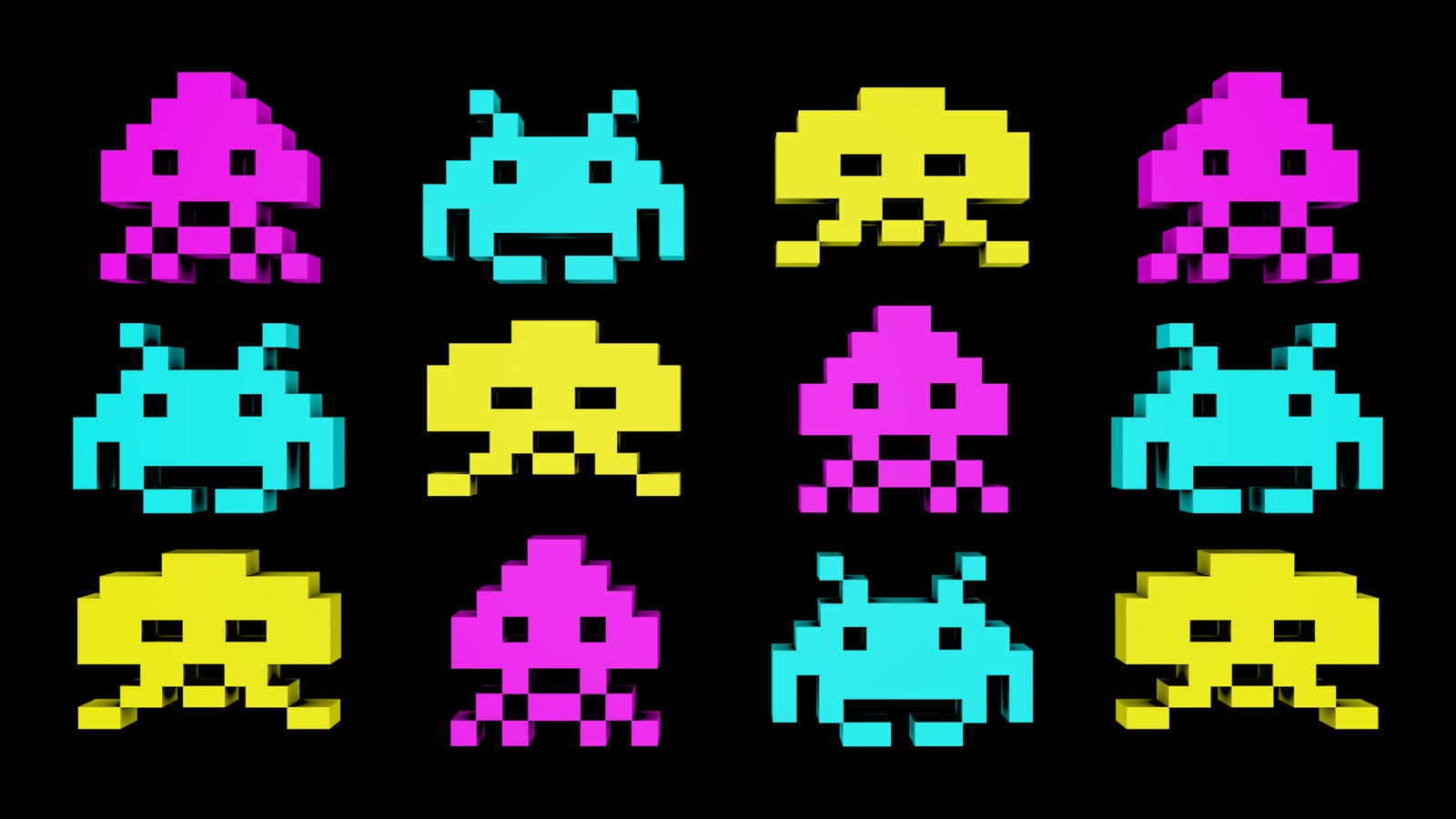
The iconic alien shapes were also a the invention of Nishikado and his team. Dissatisfied with tanks and planes, they explored advancing soldiers, which satisfied the game movement they had envisioned, but they felt that shooting at people was not a good idea. How video gaming has changed since! But I digress… Recalling the 1953 film War of the Worlds, Nishikado suggested that the targets take the shape of an octopus. That proved the perfect starting point, with the other advancing enemy shape variations taking the form of abstracted marine creatures, squids and crabs. These simple pixelated shapes have become pop classics and are instantly recognizable even 45 years on, appearing as graffiti, on clothing, as toys and a myriad of other applications.
One of the hallmarks of Space Invaders is the increased speed of attacks as the rows of alien creatures descend. Should the aliens manage to get to to the bottom of the screen, the game ends, no matter how many lives the player has remaining. This adds difficulty and excitement to the gameplay but in fact was a result of the limited processing power of early video games. Space Invaders relied on a microcomputer, something American games had started using but was unknown in Japan at the time. Not having access to the development hardware, Nishikado built his own, referring to American game boards and adding his own refinements and improvements specific to his needs. The board had limited processing power, producing one invading alien character every 60th of a second. For example, if 60 aliens were on the board, then the game would require one second to render them “stepping” across the screen. But as the number of characters decreased, the processor had to do less work to move those that remained. Thus, the speed ramped up as the game progressed.
Along with the new hardware configuration, the game introduced shields that could be destroyed by both player and enemy, continuous looping music during play and enemies that fired back. The enemy characters were interactive, responding to the player’s movements, another new feature for video games. All of these innovations became popular for use in subsequent video games, ushering in a rush of new Japanese games available to an enthusiastic public. The creators of Donkey Kong, Mario, Metal Gear, Pokemon and Doom have all cited Space Invaders as their introduction to video games. Space genre games and first-person shooter games draw heavily on the Space Invaders early influences and style of play.
Over 45 years since it’s release, Space Invaders is not just beloved nostalgia; people are still playing the addictive video game, and video manufacturers are still producing new variations. It is a game with staying power. Said Nishikado in a 2023 interview with Wired: “I didn’t have much attachment to Space Invaders for 20 years after its release. But especially during the past 10 years, I’ve discovered how many people still play and appreciate the game, and that even children know it. It’s a wonder how we were able to make it in that environment. But I now recognize Space Invaders was the best game I ever made.” As far a my own inability to excel at the game, I suppose shouldn’t feel too badly: even Nishikado admits to having hardly been able to progress past level 2 himself.
Wired: “The ‘Space Invaders’ Creator Reveals the Game’s Origin Story” by Craig Grannell, 4/12/23
The New Yorker: “Artificial Intelligence Goes to the Arcade” by Nicola Twilley, 2/25/15
This is a real thing! *Two-sided* Joust **Pinball** machine!
https://substack.com/profile/155705581-the-estivating-hibernian/note/c-53444976
Thank you once again. Besides love of the French countryside, I share with you my horrible reflexes. When my then 8yo nephew allowed me to try Mortal Combat, I was so bad he took the controller back in frustration after just a minutes. 🤪