

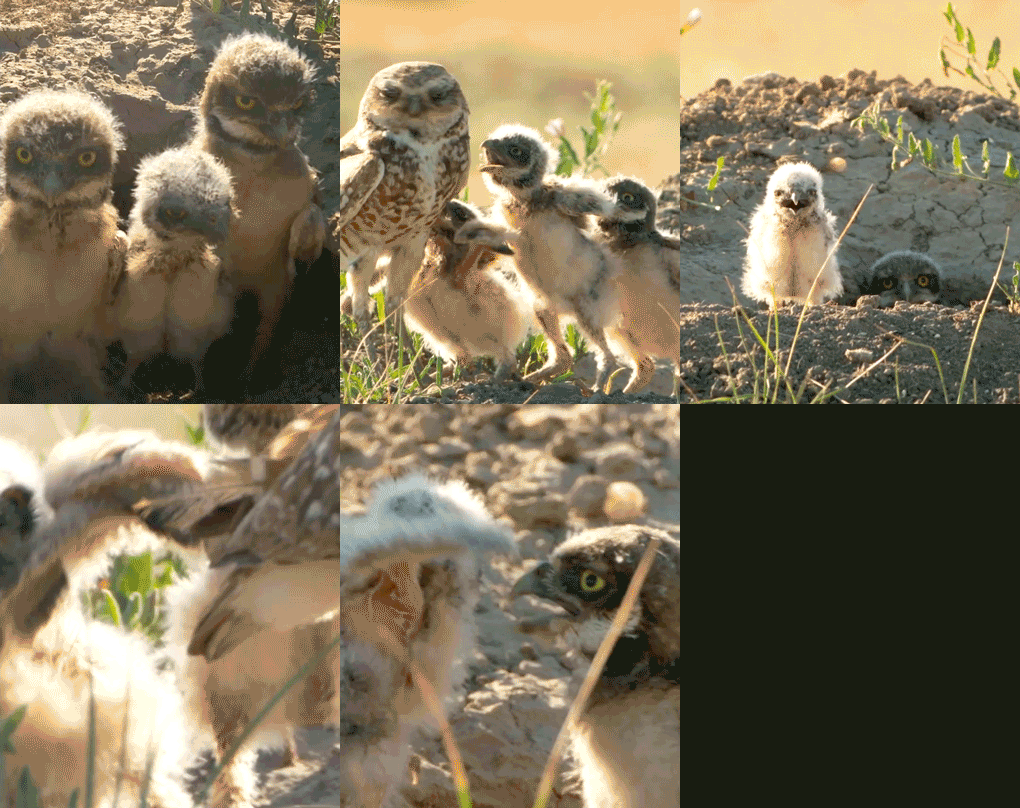
Today’s gif critters are burrowing owls—baby burrowing owls specifically. They haven’t grown their adult feathers yet, so we can assume that are only a few weeks old. This group seems to be comprised of several nests: burrowing owls may live in communities with just a few nesting pairs to up to several hundred families in close proximity. A typical brood is seven eggs, although sometimes can be as large as 12. Mom owls will incubate her eggs for about 30 days while dad owls provide food. After their clutch hatches, mom and dad share hunting and feeding duties, with mom venturing out more frequently as the children gain independence.
Hatchlings start out in the spring with a white, downy covering, which helps keep them warm. The newly-hatched babies will be completely dependent on their parents for food and shelter, not yet ready to leave their nesting site. But in three to four weeks, they will begin to develop their brown juvenile downy feathers and start to peek out of their burrows, stretching their little wings and taking short walks as they learn their environment. At five to six weeks they will be found outside longer: it is at this stage where they will initiate play with their siblings—the chasing, pouncing and flapping all skills needed in learning to hunt and fly. At six to eight weeks, they will venture a bit further, starting their discovery of flight by hopping off small hillocks to test their developing wings, their flight feathers almost fully developed. They will depend on their parents for food when babies, but by about twelve weeks mom and pop will have gradually stopped providing catches and the kids will have learned what they need to live independently through accompanying the adults, observing and participating in hunts. By summer’s end they will be capable of both hunting and flying on their own.
Fully grown, burrowing owls stand about seven to 11 inches tall and weigh between five to seven ounces. Their wingspan is typically between 20-24 inches, males having slightly longer wing and tail lengths, while females tending to be a bit heavier. As a result of their terrestrial habitat, they have evolved much longer legs than typical owl species and they usually prefer to run, rather than fly. They are capable of flight, although typically this is done in short bursts and relatively low to the ground. Like their desert neighbor the roadrunner, they sprint when perusing prey or escaping, and to gain momentum before taking to the air. They may hover above the ground in search of prey although they typically prefer to hunt from a perch. They can also catch insects while in flight.
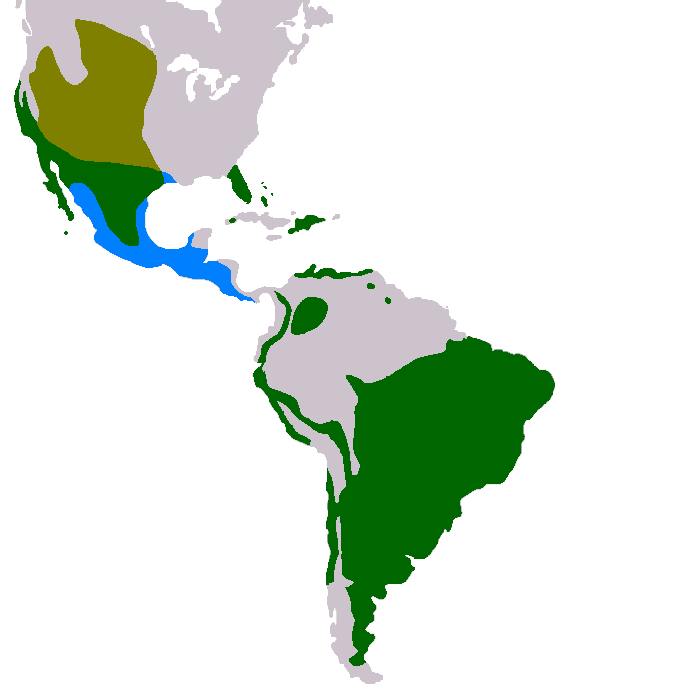
Burrowing owls are native to the open landscapes of North and South America. They can be found in grasslands, prairies, deserts and other areas where there is low, scrubby vegetation. Some subspecies are migratory, although many live in the same area year-round. As their name suggests, they nest in burrows, although they are rarely the creators of these underground homes. Instead, they will colonize the holes left by other animals, most often those left by prairie dogs, but also those of ground squirrels, badgers, foxes or other burrow-diggers. In semi-urban and agricultural areas, they might also make nests in piping and other man-made structures at ground level. They will often pile their own or other animals’ poop at their home’s exit hole to attract dung beetles, a favorite meal. Because rattlesnakes also employ burrows, the burrowing owl has learned to mimic the snake’s rattling sound, which it uses to discourage potential predators from entering the den.
Unlike most owl species, burrowing owls are active during the day. While they will shelter in their dens during the most intense heat of midday, they venture out mornings and afternoons. Still, their finely-attuned owl senses are capable of crepuscular hunting, so they will catch most of their food at dawn and dusk, reflecting the activity cycle of their prey. A burrowing owl’s diet includes small birds, reptiles, fish, rodents and large insects. As a result of more time spent during daytime sojourns, male burrowing owls tend to have lighter coloration than that of females, a result of sun bleaching.
While burrowing owls are overall classified as a species of least concern, they are threatened in certain parts of their range. Because they depend on other animals to dig their burrows, agricultural eradication of “pest” animals like prairie dogs has an adverse impact on burrowing owl populations. The use of certain pesticides to eradicate insect infestation also has a downstream impact when these owls consume toxic prey which builds up in their bodies over time, affecting egg laying and offspring physiology. And as with many other species, habitat loss due to housing and agriculture use continues to shrink habitable area for burrowing owls; although interestingly, in areas where clear-cutting and agricultural clearing has eliminated forests, the burrowing owl has colonized newly-created scrub and desert land. On balance, they are a resilient little species, and do tolerate some human presence—they can sometimes be found at the edges of suburban areas where suitable habitat is available.
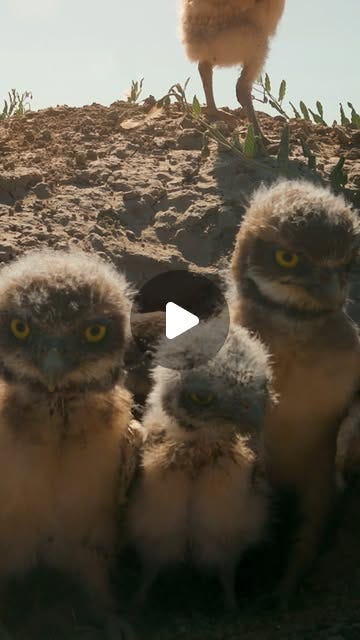
The source for today’s gif is below.
Northwest Wildlife Preservation Society: Burrowing Owls
Smithsonian’s National Zoo: Burrowing owl
Keith Ross, Bird Photography (Facebook Page): Burrowing Owl Development Stages
I love love love owls and floofy baby owls especially! Thanks Martini!
They are adorable 😊💜💜