

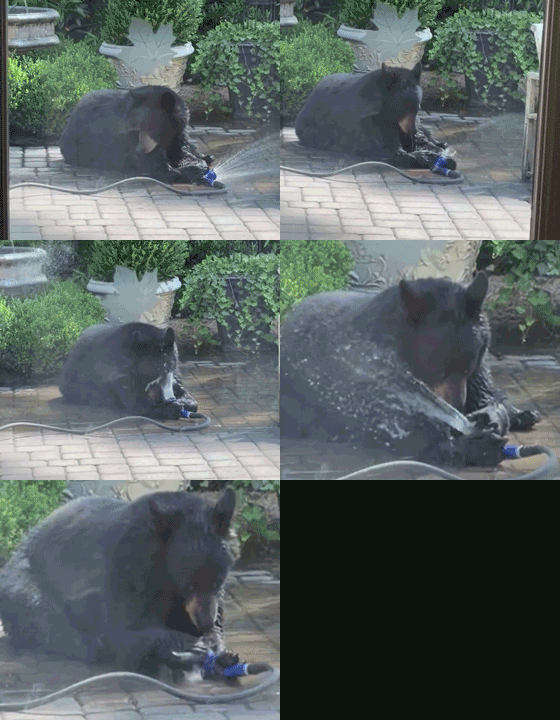
A black bear in Biltmore Forest, North Carolina (where I’ve never been but based on my map review I think seems like more of a upscale suburban town than a forest… but I digress) decided that a homeowner’s running garden hose was too tempting to pass up. He’s taken matters into his own paws and is directing that refreshing water at his own head and body. Check out that dexterity!
Bears are surprisingly adept at manipulating objects with their paws. While their claws are not retractable and therefore they can’t grasp items like primates can, they do use their paws for digging and scooping. These are helpful skills when foraging for small items like berries or extracting insect larvae. Combine this dexterity with a high level of intelligence and strong spatial memory, and bears can apply their problem-solving skills to overcome many human-created obstacles; opening lever-style door handles, untying knots, unscrewing lids and opening trash-can locking mechanisms. In Yellowstone National Park, researchers have documented bears learning how to open increasingly complex “bear proof” containers. If brute force doesn’t work, they will employ more sophisticated tactics, building on prior observation, experimentation and adaptation. They can even exhibit learned behaviors to other bears, passing on their knowledge to cubs or others in their social group.
While these abilities can sometimes mark bears as nuances when bear habitats overlap with those of humans, their intelligence and spatial skills serve them well in the wild. They can remember where food sources are over large areas, and they can even recall when these sources will be seasonally available. For example, a grizzly might know when to forage in a particular forest for nuts, where and when berries might ripen, and when salmon will run at a particular stream, all across a territory that might span hundreds of square miles. Being omnivores, bears rely on a wide variety of food sources which might change through the seasons. The ability to predict where and when food will be available is essential to survival. And so bears have developed the ability to build and recall detailed mental maps.
While the studies of bear intelligence have lagged behind easier-to-study animals, research by such notables as Ben Kilham and Jennifer Vonk is catching up to the point of acknowledging that bears are probably a lot more intelligent than what we humans have thought of them, perhaps even at a level approaching those of great apes. While the study of emotional intelligence is more complicated and at times more controversial to attribute to animals, some researchers believe that bears may be deeply affected by events such as death. Recognizing that bears are more complex than simple brutes are opening up new lines of inquiry in understanding bears and the way they interact with their environment. Greater knowledge of how bears think and learn will foster more harmonious interactions with our ursine friends, helping develop more effective conservation strategies, smarter wildlife management techniques, and overall help foster a better, more respectful relationship with them.
The source for today’s video is here.
Sierra: "Does a Bear Think in the Woods?" by Brandon Keim, 2/26/19
What do a black bear in Biltmore Forest, North Carolina and a g̶e̶e̶z̶e̶r̶ ̶ golden ager in Chicago have in common?
If you guessed "a keen understanding of what a garden hose can do for you during a heatwave" come jump through the sprinkler!
"...that bears are probably a lot more intelligent than what we humans have thought of them..."
Of course, bears are intelligent. How else do you think they steal all those pic-a-nic baskets. Yogi and Booboo to the rescue! Thanks Martini for the cute video of the bear but I'm still not hugging him.