

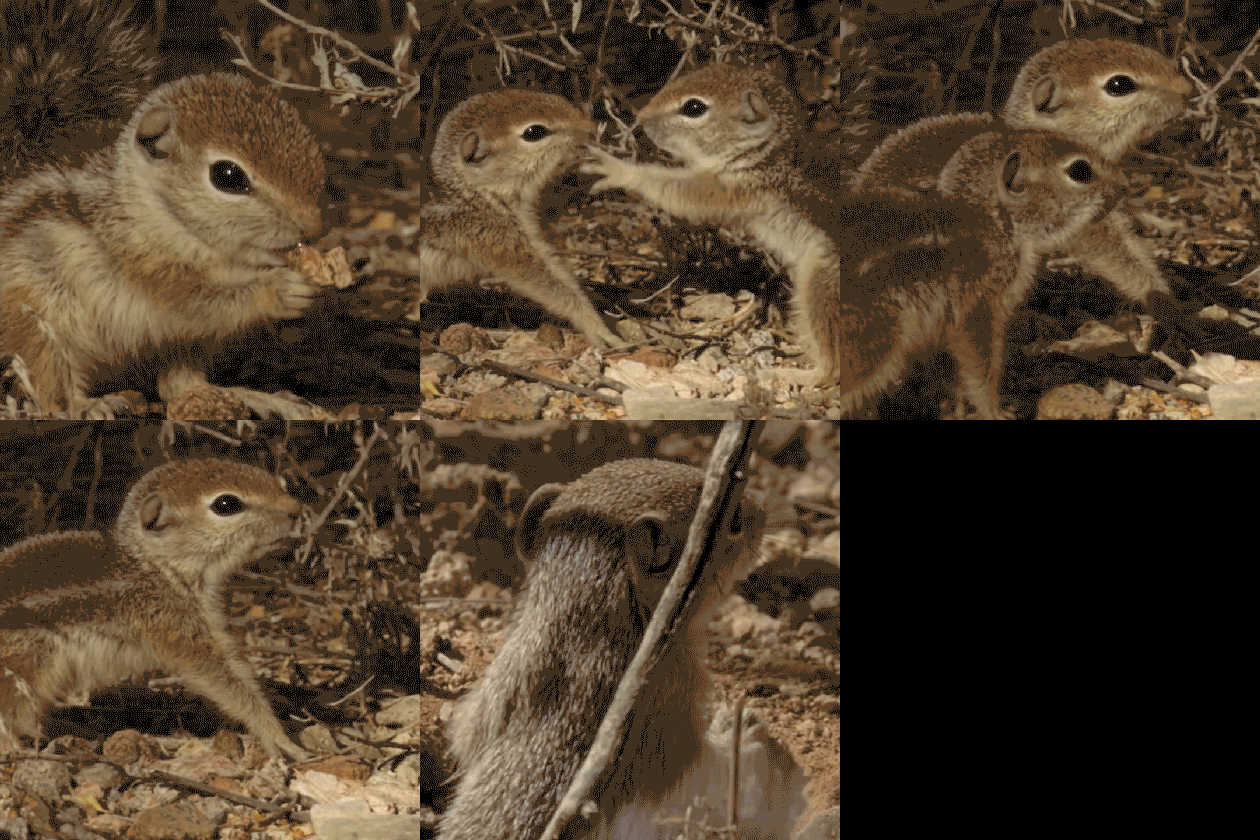
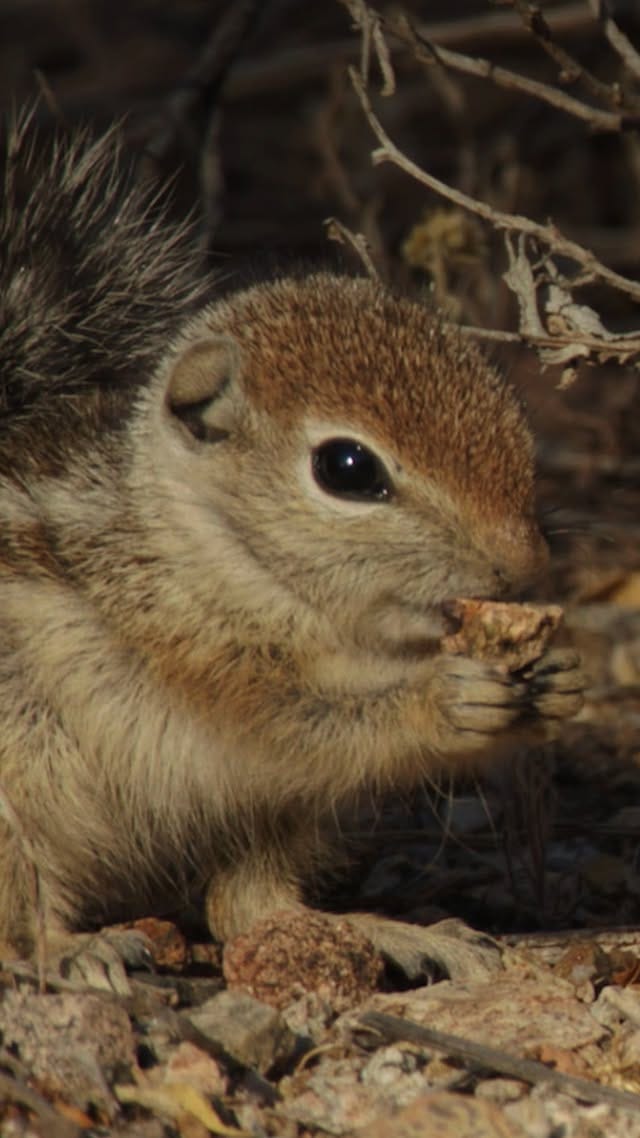
Nat Geo animals today brings us some great footage of Harris’s antelope squirrel kits out of their den, exploring their surroundings and generally having a good time. This species of squirrel is a native of the Sonoran Desert region of Mexico, and Arizona and New Mexico in the US.
Smaller than the eastern gray squirrels that one sees all over North America, the Harris’s antelope squirrel grows to between 22-25 centimeters and weighs about 120 grams (that’s 8.5-10 inches and 4.2 ounces for you imperial measurement types). Adapted to a hot environment, they cool themselves by “heat dumping;” this is a technique where the squirrel finds a cool, shady spot and lies spread out flat on the ground, something you may have seen your own cat or dog or a carefree child doing during scorching weather. Additionally, they will use their flat, tufted tails as umbrellas to protect themselves from the sun. They eat the fruit and seeds of the cactus plants in their habitat, insects, small rodents and carrion.
Your source vid is below.
TIL that what I know as a "sploot" is really called "heat dumping". Thanks!
We had squirrels like that in the deserts around my neighborhood in El Paso when I was a kid. We called them "ground squirrels." They make a high-pitched call, which I'm thinking is likely a warning call. We could go out in the desert and from time to time hear one, but rarely see one.
Except, one day, there was one in the yard of a house a couple blocks from the desert. I thought to catch it, as I might a lizard or a horny toad. As I started to take it up in hand, it turned and gave me a quick bite. It wasn't a hard enough bite to break the skin, but it was clearly a warning that the next bite would be more serious. I let go of the squirrel and backed off while it scampered away.