
Salmagundi!
A sprinkler drink(l)er, an etymology from salad, and a thorny history surrounding an early dictionary... all in a single post

Today’s gif features a thirsty kitty going directly to the source, lapping up droplets from a sprinkler. You have to admire his sense of timing, syncing those licks with the frequency of the water reaching his tongue. And with such a nonchalant attitude about it all!
When I saw this video, I wanted to be sure to use it. Because to me it symbolizes the firehose of information, but more precisely the selection of curated tab links we enjoy from our Wonkette writers in the morning. Of course they cover the big and important news stories and political insanity that dominate the news cycle every day, but each poster also brings their own particular spin to Tabs, covering a range of topics that are as varied as they are interesting and entertaining. (Plus, the video features a kitty, and I certainly am not above pandering to the readership and their love of felines.) So with Tabs we get the critical news, politics and cultural trends that we need in order to better understand what’s happening in the world around us. But beyond that we are also treated to samples of music or stories about the arts or history or Thornton the kitty pictures or vacation recaps or whatever: things that are personal, miscellaneous and delightful to offset the insanity of current events, a potpourri of tastes and interests, a salmagundi of topics. If you are able to support this special, quirky and vital little corner of the Internet, operators are standing by to take your call! OK, it’s really more like you could click a button, which is here.
The origin of salmagundi derives from the world of cooking, a name for a salad composed with a large number and variety of items, providing diners a range of flavors and textures brought together on a single plate. The earliest known use of the noun in English is in the late 1600’s and it is first mentioned in writing in 1656, in lexicographer Thomas Blount’s ambitious Glossographia; or a Dictionary Interpreting all such Hard Words of Whatever language, now used in our refined English Tongue. Blount’s definition for salmagundi specified "a dish of meat made of cold Turkey and other ingredients.”
While similar to a language dictionary we might use today with word definitions and etymologies, Glossographia was not meant to define all English words currently in use. Instead, it was a “hard word” dictionary consisting of about 11,000 ordered words, meant to aid the non-academic middle class in understanding words or terms that they might encounter in literature or professional writing. Blount was a member of the aspiring and growing middle class and had trained to be a lawyer, but retired from the profession due to anti-papist sentiments in England at that time, largely restricting the participation of devout Roman Catholics like himself from engaging in much of public life. His retirement to his modest-but-comfortable estate gave him the time to devote to the amateur study of law and for extensive reading and immersion into other branches of knowledge.
Blount published several scholarly works, with Glossographia being one of his best-received and at the time the largest English dictionary ever to have been compiled. But Blount’s triumph of lexicography was eclipsed less than two years later by Edward Phillips’ The New World of Words, published in 1658. New World was intended to be a dictionary covering both common and obscure terms and contained about 20,000 words, proving to be even more popular than Glossographia. However, on comparison it became clear that more than half of the definitions in this later work had been copied directly from Glossographia. Blount was understandably enraged by the plagiarism, denouncing Phillips in both speech and writing, and publishing A World of Errors Discovered in the New World of Words in 1673 as a systematic takedown of Phillips’ inaccuracies and appropriations. The feud escalated with Phillips calling terms from Blount’s list “barbarous and illegally compounded.” And so it went, with the dispute ongoing until Blount’s death in 1679 at the age of 61, Phillips “winning” the debate by default.
In addition to his dictionary, Blount published widely on a variety of other subjects, including a book of rhetoric designed to help young reader speak and write eloquently, an almanac of Catholicism, a history of Charles II’s escape following the Battle of Worcester, a scholarly work on antiquities and historical customs, and a law dictionary filled with obscure words and terms: a tome designed to help the people in the very profession from which he himself was excluded. Probably less well-known than his contributions deserve, circumstances were not kind to Blount. He was forced to flee his home and for a time became a wandering fugitive in the wake of the fabricated Popish Plot of 1678. Further, he contacted palsy during the last year of his life. Still, Glossographia sold well enough to merit at least five revisions and even more reprintings, one as recent as 1969.
But let us refocus our attention towards the salmagundi of salad. For here, it is unclear where the term originates. While Blount ascribed an Italian origin of the word (as from the term for pickled meat, salami conduit), some historians say that the French might also lay claim to the word’s origin based on an obscure 16th century word salmigondis, meaning a disparate and incoherent assembly of ideas, items or people. What is clear is that by late in the 17th century, the manor houses of England had started to apply the word to the describe the grand composed salads that were the fashion of the era. These creations were recipe descendants of the raw salads containing mixed herbs and edible flowers that were considered important medicinal nourishment coming out of medieval tradition, with careful consideration taken in balancing the warmth of aromatics with cool leaves of lettuce, pursalane or endive. In the Elizabethan era, fruits, vegetables and hard-boiled eggs had started to make appearances in ever-more elaborate plates of salmagundi.
By the 18th century, salmagundis had become extravagant affairs, a palate for showcasing the bounty of the household and lavish imagination and artful hand of the chef. Cooked, cold meats or poultry (sometimes both), usually chopped, would be carefully arranged on the salad platter along with oysters, fish, all manner of cooked or raw vegetable, fruits, seeds or nuts, edible flowers, pickles and greens. The large assortment of ingredients would be selected to give the diner a colorful, complex and complimentary range of flavors and tidbits to be enjoyed from a single dish. Bowls of dressing might be centered on the platter or could be passed separately for table service, not to be applied until it was time to eat.
The United States too enjoyed salamagundi, a result of English colonization at the height of the salad’s popularity. Mary Randolph, in her 1824 housekeeping manual and cookbook The Virginia House-Wife instructs:
Turn a bowl on the dish, and put on it, in regular rings, beginning at the bottom, the following ingredients, all minced: anchovies with the bones taken out, the white meat of fowls, without the skin, hard boiled eggs, the yolks and whites chopped separately, parsley, the lean of old ham scraped, the inner stalks of celery; put a row of capers round the bottom of the bowl, and dispose the others in a fanciful manner; put a little pyramid of butter on the top, and have a small glass with egg mixed as for sallad to eat with the salmagundi.
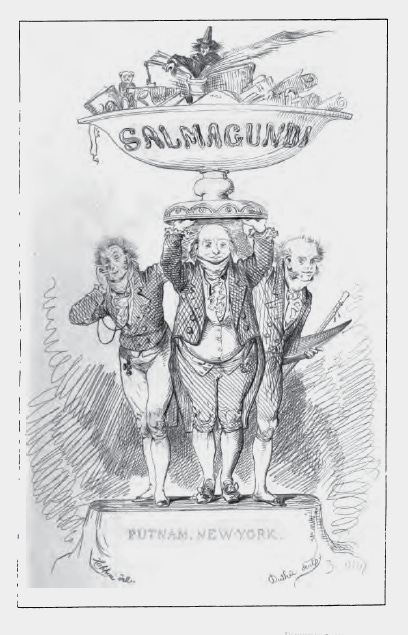
In 1807, Washington Irving with his like-minded group of friends, the “Lads of Kilkenny,” took the word “salmagundi” as the title for their satirical magazine, the concept being that the publication would consist of a hodgepodge of ideas arranged in a single publication. The magazine skewered the mannerisms and politics of New York’s elite and it is where “Gotham City” was coined as a nickname for New York City, implying that its residents were creatures of folly. Irving took the name from the English village of Gotham in Nottinghamshire, the setting for a tale called The Wise Men of Gotham wherein the town’s residents feign idiocy in order to avoid a visit from the king which would have led to an unwanted public highway through their community. I find it amusing that the same man that wrote the literary classics of The Legend of Sleepy Hollow and Rip Van Winkle was also involved in an early Mad Magazine -style satirical publication with wordplay that would have amused in-the-know readers of the day.
While perhaps not as extravagant as the composed salads of grand houses of yesteryear, modern salmagundis still enjoy an occasional visit to British (and American!) luncheon tables and picnic baskets. A clever way to use leftovers, think of your personal version of salmagundi as more of an improvisation; a way to combine what you have on-hand to suit your tastes of the moment. Serious Eats has some suggestions for making your own, which I think is a good springboard for trying your hand at a bespoke salmagundi. And have fun with it: your canvas is the plate and your paints are the ingredients.
The source for today’s kitty is here.
Merriam-Webster: A Miscellany of Words for Whatever
The Etyman™ Language Blog: "salmagundi" by Etyman, 8/16/11
Internet Archive: Glossographia (in which I looked for but could not find the entry for salmagundi, but found the book a delightful browse nonetheless)
The Phrontistery: Compendium of Lost Words, Dedication: Thomas Blount
Wikipedia: Thomas Blount (lexicographer)
Savanah Now: “Explore the ancient art of salmagundi” by Damon Lee Fowler, 1/25/19
Wikipedia: Salmagundi (periodical)
New York Public Library: “So, Why Do We Call It Gotham, Anyway?” by Carmen Nigro, 1/25/11
My mother was a great salmagundi-er. The day before payday anything left over from the prior week ended up on the dinner table. Which probably accounts for my cast-iron stomach.
The Wonkettariat -- a community of kitties lapping at streams of news and information.