
Marmot Melee
Wrestlin' in the walkway, fracas in the footpath, skirmish beyond the stepping stones

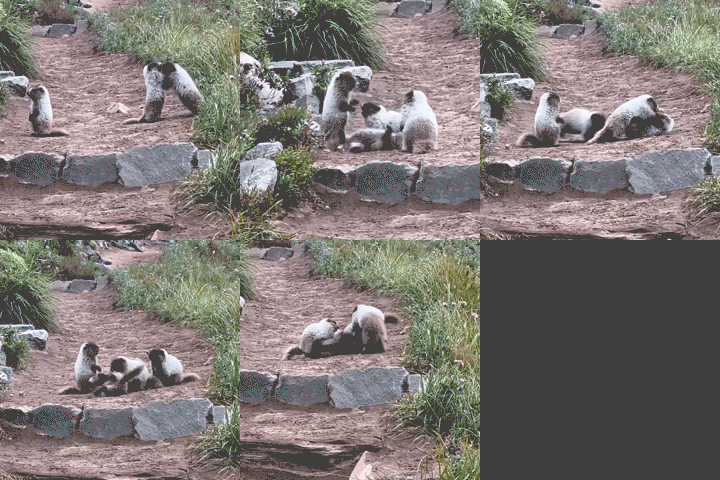
Oh dear, it looks like the marmot pups are at at again. Their rambunctious fight has spilled out onto to street (or more accurately, on to this walking path) and they are causing a giant scene. The neighbors shake their heads. But the neighbors will simply need to live through this phase. Marmots pups often mix it up on their way to learning social skills and building coordination. When they are adults, they’ll need these abilities to defend turf and compete for mates.
One of those guys might be Alan; or possibly Steve…
Marmots are large ground squirrels of the genus Marmota, with species are found in Asia, Europe and North America. There are 15 species of marmot, all herbivores and usually living in social groups. While the person that posted the marmot scrum didn’t indicate, I’m guessing that this was filmed in or near Oregon, where she lives. It’s a bit hard to tell for sure from the video, but these look like hoary marmots, who have a range that doesn’t quite reach far enough south to Oregon, so I’m thinking this was filmed in Washington state.

Hoary marmots get their common name from the frosty silver-grey fur on their shoulders and upper back. They are the largest North American ground squirrel. Adults range from 24 to 32 inches in length and weigh generally on average between 8 and 15 pounds, their weight fluctuating seasonally. It is a species with sexual dimorphism, with males growing significantly larger than females. In peak bulking-up season in the fall, some males can regularly reach 22 pounds, and a hoary marmot of 30 pounds has been observed.
Marmots are hibernators, subsisting on fat reserves during the winter, an evolutionary strategy that help them preserve energy during the months of cold and low food availability in the inhospitable habitats where they live. They hibernate seven or eight months a year, slowing their metabolism to by dropping their heart rate to as low as 30 beats per minute (vs. their waking 180-200 beats per minute) and lowering their body temperature to near freezing, relying entirely on stored body fat during this time. They enter their burrows in the fall and don’t emerge again until the late spring months. They will hibernate alone, plugging up the tunnel leading to their sleeping chamber with a mix of dirt, vegetation and poop to keep it protected from the elements.
Hoping to raise awareness and the profile of our marmot friends (specifically, those of the yellow-bellied species), the Rocky Mountain Biological Laboratory (RMBL) has started an annual Fat Marmot Week contest. RMBL runs the Marmot Project, one of the world’s longest-running studies of these wild mammals. Voting for the best bulked-up marmot begins August 24th. The chonky candidates and voting information can be found at the Fat Marmot Week website.
Hoary marmots eat all sorts of greens during the non-winter months to maximize their reserves, including grasses, berries, lichens, mosses, roots and flowers. But they are selective grazers, choosing only the food that they like best in times of abundance. They, like all marmots, are diurnal, resting in sleeping burrows during the evening and emerging during the day to feed. They live in colonies of up to 36 individuals, consisting of one dominant adult male, up to three adult females, perhaps a subordinate adult male, and a clutch of young and subadults. They are vocal animals, communicating with a series of calls, chirps, whistles and growls. They readily socialize with other members of their colony, touching noses, play fighting and performing social grooming. Towards non-colony members they are less cordial, the females usually taking on the task of chasing interlopers away.
Hoary marmots are found in rocky areas, grassy alpine meadows and scrubby sub-arctic forests. The often excavate their burrows with their clawed front paws under or among large rocks, helping to protect them from a potential predator, such as a wolf, bear or coyote that might want to dig them out. Similar to those of their prairie dog cousins (also members of the Sciuridae family), marmots’ burrow colonies can be complex. Each colony maintains a single large resting hollow (a hibernaculum) with several points of egress, and a number of connected smaller chambers which are used for sleeping. Their resting dens are typically dug to at least 10 feet deep or even up to 20 feet, lined with comfy plant material. The depth keeps them below the frost line during hibernation season. Other burrows are used for hiding from predators. Refuge burrows are numerous, each colony digging about five a year, consisting of a single escape hole dug deeply, anywhere from three to seven feet long. Established colonies might have a hundred or more such burrows.

Hoary marmots enjoy sunning themselves on rocks, and spend almost half of their morning hours doing so. In areas that humans frequent, hoary marmots are not particularly shy creatures and unlike prairie dogs don’t immediately scatter when humans are nearby. They do, however, keep a close eye out for predators and will sound an alarm if a threat gets too close, signaling other members of the colony of the danger and giving them time to retreat to one of the refuge burrows.
Hoary marmots arrange their breeding schedule around the end of hibernation, copulating shortly before or after seasonal emergence from their burrows. Females typically raise litters in alternate years. Gestation lasts 25 to 30 days, resulting in a litter of three to eight pups. The youngsters emerge from the den at three or four weeks of age and will have already started weaning by this time. Subadults remain with the colony for about two years, after which time they will depart to find new territory and to eventually breed. They reach full sexual maturity at about three years old. Their average lifespan is 13 to 15 years old.
The source for today’s gif is here.
Marmot melees are the best melees!
"Mom said that we could fight in the pathway!"