

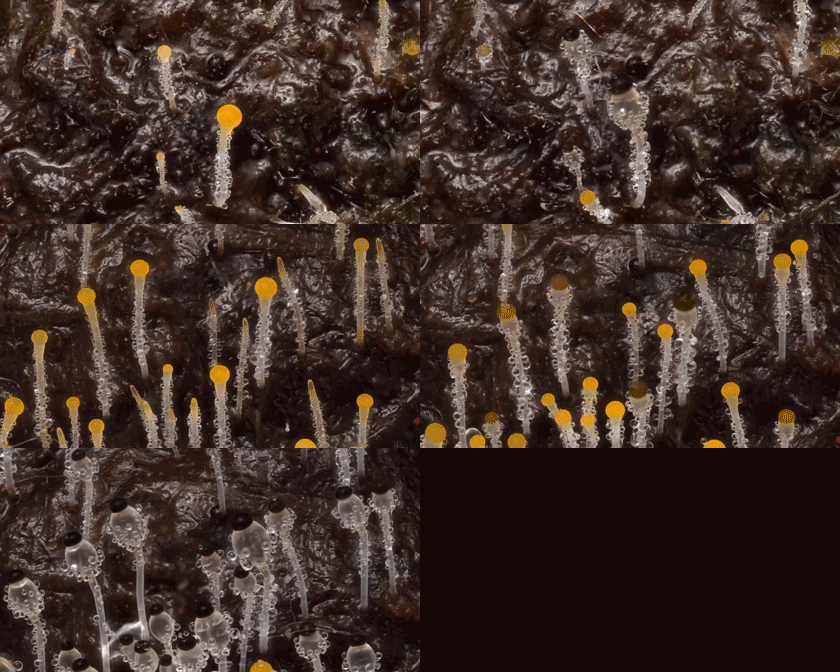
Today’s gif is entitled “Hat thrower fungus (Pilobolus) on rabbit dung,” which is what it is! The micro world is surprising and strange. This video won an honorable mention in Nikon’s “Small World in Motion” competition for 2025 and was taken by Wim van Egmond for the Micropolitan Museum in in Berkel en Rodenrijs, Zuid-Holland, The Netherlands. The video was shot at 5x magnification and composited using image stacking.
Pilobolus crystallinus is commonly known as the "dung cannon" or "hat thrower.” These fungi grow to be 2–4 cm tall. Their spores develop in a bundle that sits on a fluid-filled bladder on a stalk. As the fungus matures, the bladder expands until the internal pressure causes it to squirt out its contents in a powerful jet, propelling the spores away at speeds of up to 90kph (56 mph). Top speed is reached in only a few millionths of a second, a rate of acceleration that is even faster than that of a bullet shot from an AK-47 rifle.
As the fungus grows, it will orient itself towards a light source. In this way, when it discharges its spores, it will have shot them in a place that is most likely a sunny space where vegetation such as grass will be growing.
The spores are surrounded by a mucus which sticks to vegetation. When the affected plant matter is eaten by grazing animals, it passes through the animals' digestive systems. The fungus then grows in the expelled feces, thus completing its lifecycle. Through this method, this fungus has developed a clever evolutionary adaptation—an ability to disperse from up to 2 meters away from its source, a dung-covered area that is unappetizing to the animals it depends on to propagate, to a new place where animals might consume it and ultimately provide new conditions for its continued survival.
You can find the source for today’s gif on Nikon’s site, linked here.
Ta, Martini. Fungi throwing hats! What fun.
Science is interesting, even when involving rabbit dung.