

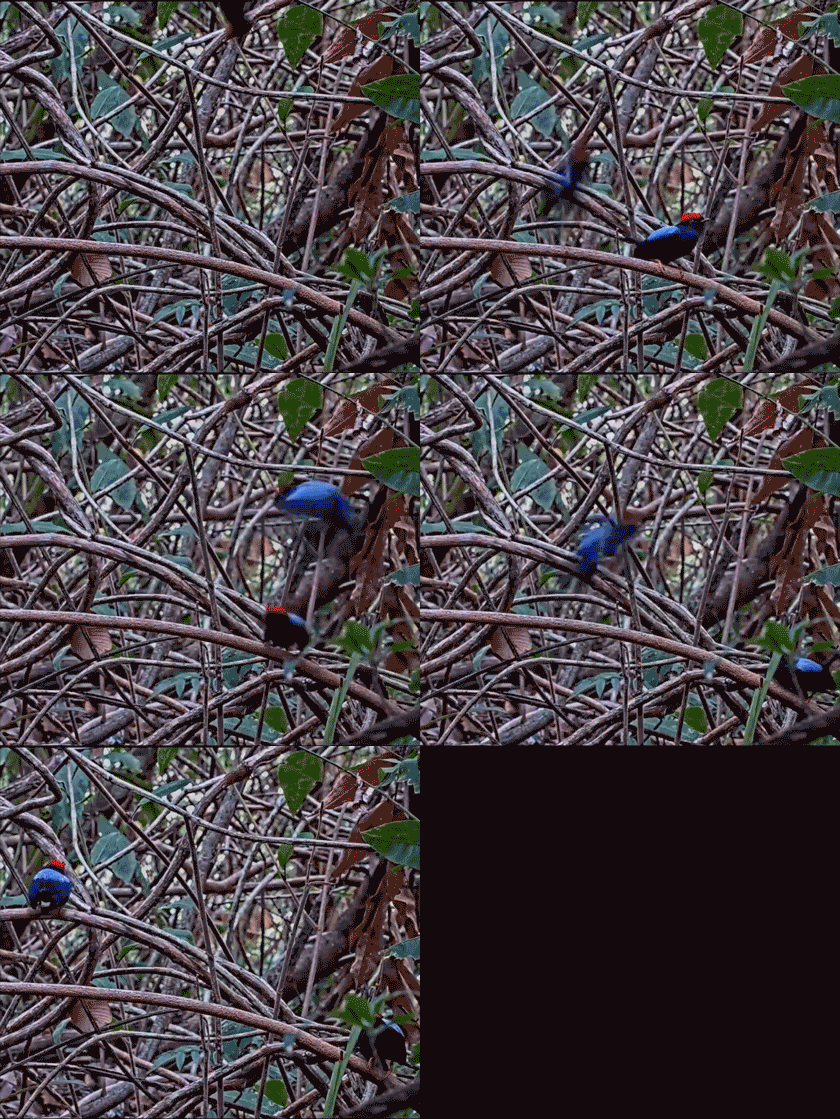
Today’s gif is taken from footage streamed from the Lance-Tailed Manakin Cam in Isla Boca Brava, Panama set up by Cornell Labs and sponsored by DuVal Lab at Florida State University. We are watching a display put on by this pair of lance-tailed manakins that reveals a special and rather unique behavior within the animal kingdom.
Lance-tailed manakins are passerine (perching) birds in the family Pipridae (manakins). There are 55 species of manakins distributed throughout the American tropics. Highly arboreal, they favor forests and woodlands, with most species having ranges within humid tropical lowlands—although some species can be found at higher elevations. They are small, compact, plump birds, ranging from 7 to 15 cm in length depending on species. Their name comes from the Middle Dutch word mannekijn, meaning "little man." With their frequently-colorful plumage, large heads, short tails, and short bills, they perhaps did resemble stout little well-dressed men for the naturalists that gave them the name.
Lance-tailed manakins are typically 13.5 cm long and weigh 17.5 g. They are found in secondary growth forests of Western Panama, Columbia, and Venezuela. Like most other species in the manakin family, they show distinct sexual dimorphism in their plumage coloration. Both sexes have bright orange legs and two central tail feathers elongated to form a spike (hence their common name). However, males are black with a blue back and red crest, while females are olive-green and have an orange or red crest. Young males initially look like females, but pass through two intermediate plumage variations before attaining their adult coloration, which they develop at four years old.
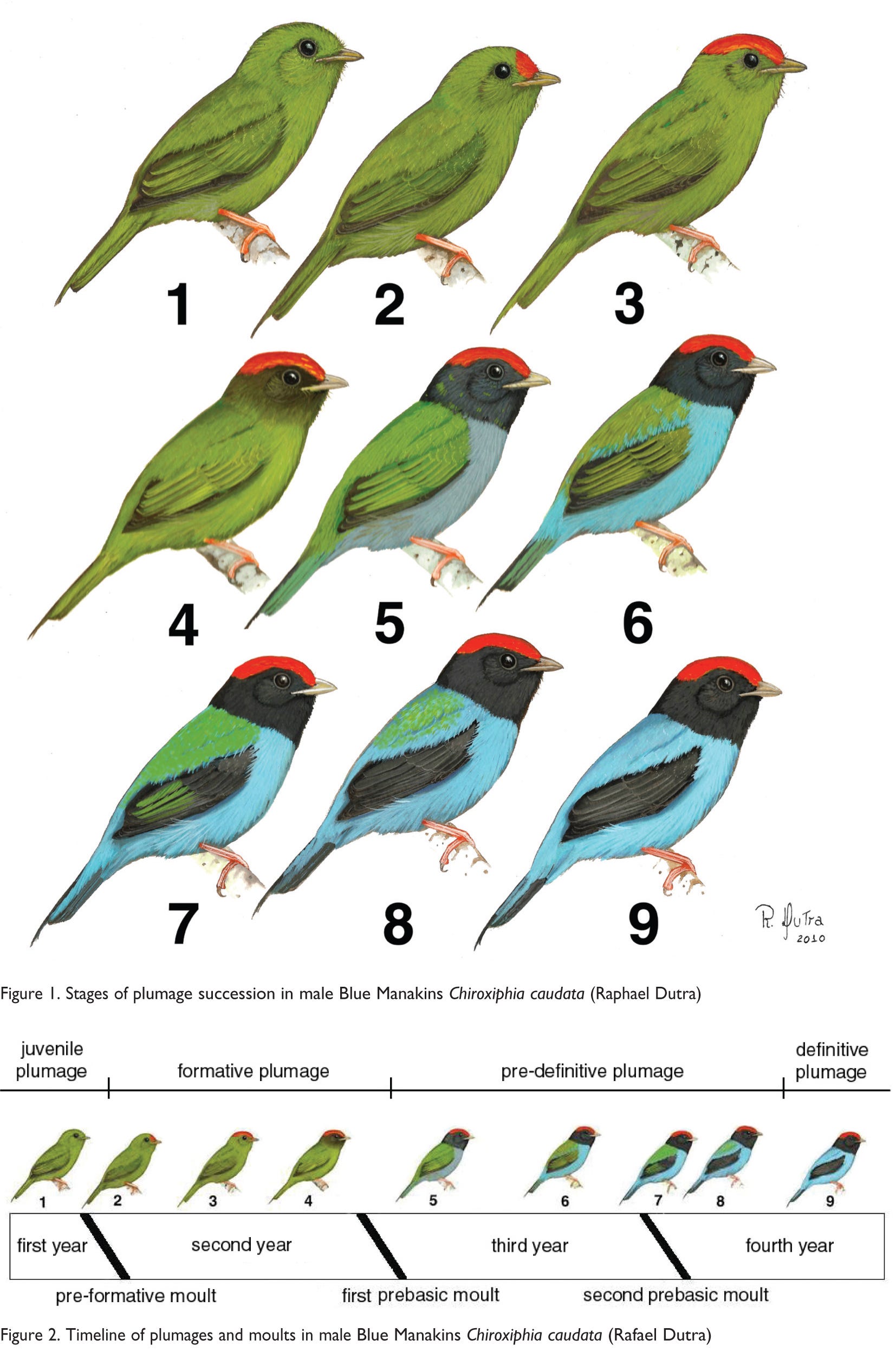
So, looking at the colors… if those are two males in today’s gif, what are they doing performing mating dances with each other? Here’s where things get freaky (ok, not so much “freaky,” but we are seeing behavior highly unusual in the animal kingdom).
Male lance-tailed manakins form cooperative, rather than competitive breeding partners, with pairs joining long-term two-male alliances. The partners select a special branch in a tall tree and will stand on it side-by-side to sing duet songs. When a female approaches, they perform a coordinated dance, leaping one over the other and taking butterfly-like flights from their display perch. All of that coordination requires practice, which is what is being shown in today’s gif: two dudes getting the moves right so that they can impress a lady when she arrives.
A concentration of male display perches is called a “lek.” Females visit the lek to watch the dancing male pairs, taking several days to evaluate and finally select a breeding partner out of the typical four to six groups she’ll observe. The alpha of the breeding-dance partnership gets mating privileges, while the (almost literal) wingman (wingmanakin?), the beta, will depart before mating begins. While betas do not reproduce in these situations, they will be using their time to watch and learn. Age and experience are important factors in selection success. The betas of more successful alphas have a better chance of becoming alphas themselves at a later date.
The chicks that result from a mating have a naturally high mortality rate, with only about 30% fledging in a good year. But the birds that do survive are long-lived. The alpha from today’s gif is well-known to watchers and is reaching his 20th birthday this year. His partner is five years younger, having served as a beta for several partners over the years, and even attempting alpha status himself in 2021 before returning to the beta role. Presumably, he’ll attempt alpha status again when he gets a bit older and picks up a few more dating tips.
A breeding male and his partner will return to display perches for many seasons. They may dance on two or three perches within a lek during a season, but typically will frequent a favorite for their best exhibition. This routine does make it easier for birdwatchers to anticipate optimal observation sites, even though setting up cameras can be a challenge when trying to catch the action on higher trees and in more densely forested areas. The breeding area at Isla Boca Brava, Chiriquí, Panamá has been monitored intensively since 1999. The oldest bird in the observation group is 26 years old this year—I’m gonna guess the ladies find him irresistible.
Lance-tailed manakins are primarily frugivorous. Like other species of manakins, they play an important role in seed dispersal in their tropical environments. They are listed as a species of least-concern by the IUCN, being well distributed within their range.
Check out Cornell Lab’s eBird page to view the mating perch cam live here. The page also has saved some video highlights, including courtship display practice and some showing off for a female bird that stops by to watch the action (it’s really quite cool, watch with sound on!).
The source for today’s gif can be found here.
"Ready?"
"Ready. Do you see her?"
"Here she comes."
"Yippee!"
"Time to dance, friend."
"Let's get down!"
"No, that's what I say to her."
Cooperation? Pfft! That's for the birds!