

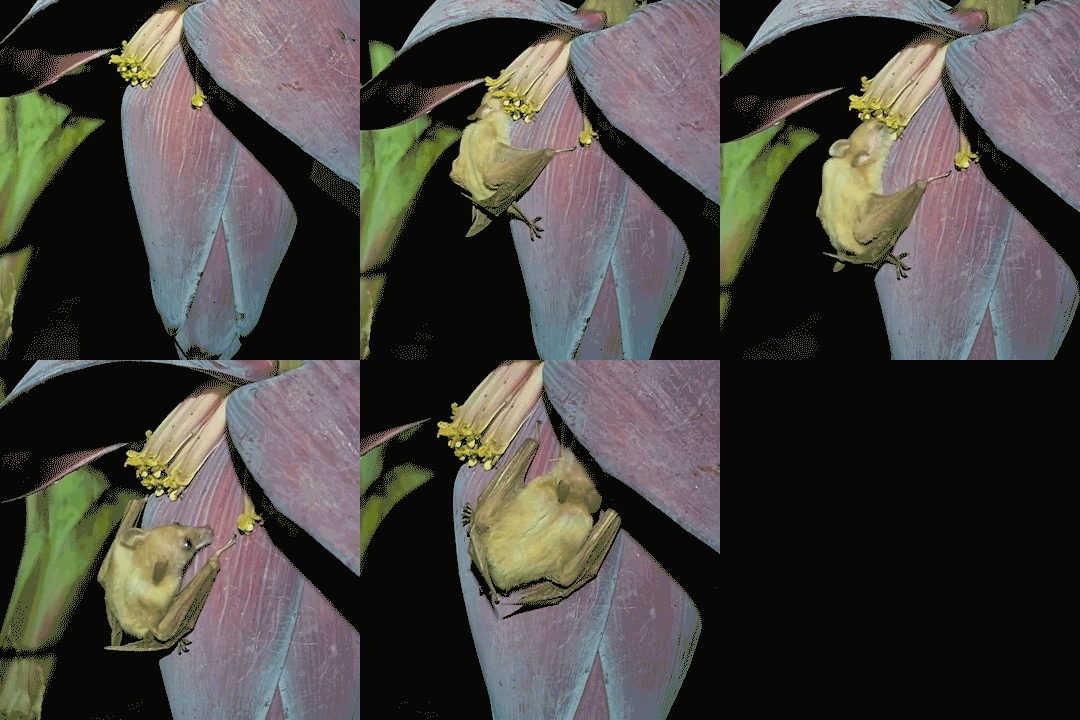
Today’s adorable little critter is a blossom bat (Syconycteris australis) having a bit of snack on a banana flower. These small, nocturnal pollen-feeders are found in tropical rainforests in New Guinea, at the extreme northeast of Australia, and on a few other islands in the region. They belong to the same family as flying foxes (the family Pteropodidae, also known as “megabats”) and they share the similar fox-like face with rounded ears and a pointed muzzle, but unlike their distant cousins they are much smaller, and they eat nectar and pollen instead of fruit.
These little bats locate flowers using sensitive olfactory perception. In response, some flowering species of plants have evolved a musty “bat odor” and only open at night. The bats have developed very long, thin tongues covered with brush-like projections to pick up nectar and pollen from the flowers they feed on.
Blossom bats weigh less than three-quarters of an ounce and grow to about 2.4 inches long. They roost in the forest canopy alone or in small groups. Unlike most bats, they do not roost in a centralized location and their roosts can change daily, as the bats move each the night to feed. These habits make it difficult to count and observe the species, although with their wide distribution they are considered a species of Least Concern by the IUCN.
Being largely solitary, blossom bats do not benefit from the shared warmth that other bats enjoy from huddling behaviors. Further, the blossom bat habit of roosting in the subcanopy provides them little protection from the elements. As an adaption, they will enter a state of torpor during colder months, reducing their metabolic rate and reducing their core body temperature. They also enter torpor when food supply is low.
Blossom bats are thought to be important pollinators, carrying six times as much pollen as birds and traveling greater distances during their nightly foraging. They have a high rate of metabolism, requiring visits to the equivalent of 36-48 cost bankasia flowers every night, and actively foraging during a large proportion of the nighttime hours. That’s a lot of pollen exchange!
The source for today’s gif is here.
Tiny wee warm blooded pollinators! Between solitude and the occasional torpor, I feel an attraction, spirit animal?
We've been alternating between downpours and incubator temperatures for weeks now, which has been great for the mosquito population and other insects of the pest variety... So, of course, my thoughts turn to bats... The more common species, of course...
This just might be the year for looking into mounting a bat house...
Thanky, M
Special creature for us all.
(both creatures, The B.B. and M)